« Fortuny, un Espagnol à Venise » c’est l’intitulé d’une exposition au Palais Galliera, musée de la mode de la Ville de Paris,organisée avec la participation exceptionnelle du Museo del Traje à Madrid et du Museo Fortuny à Venise.
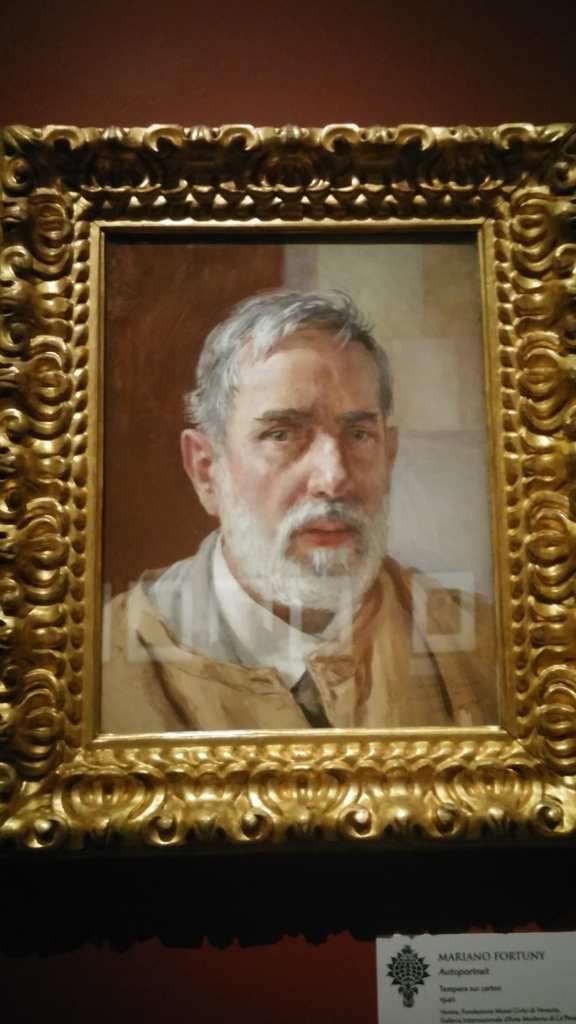
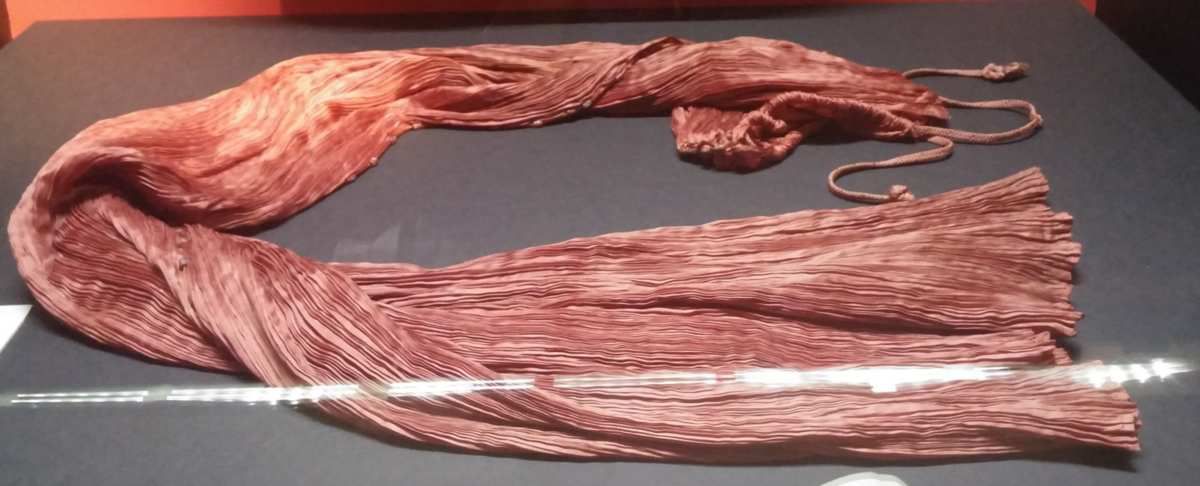
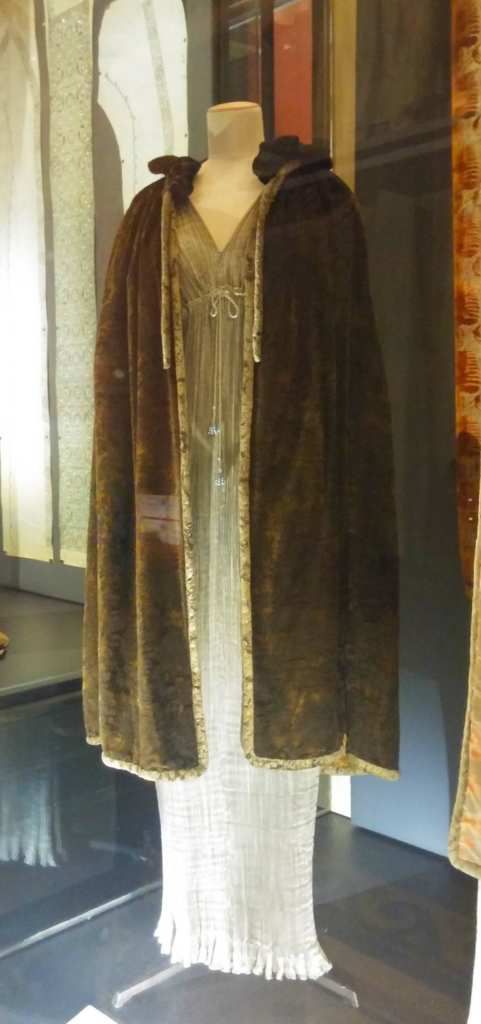
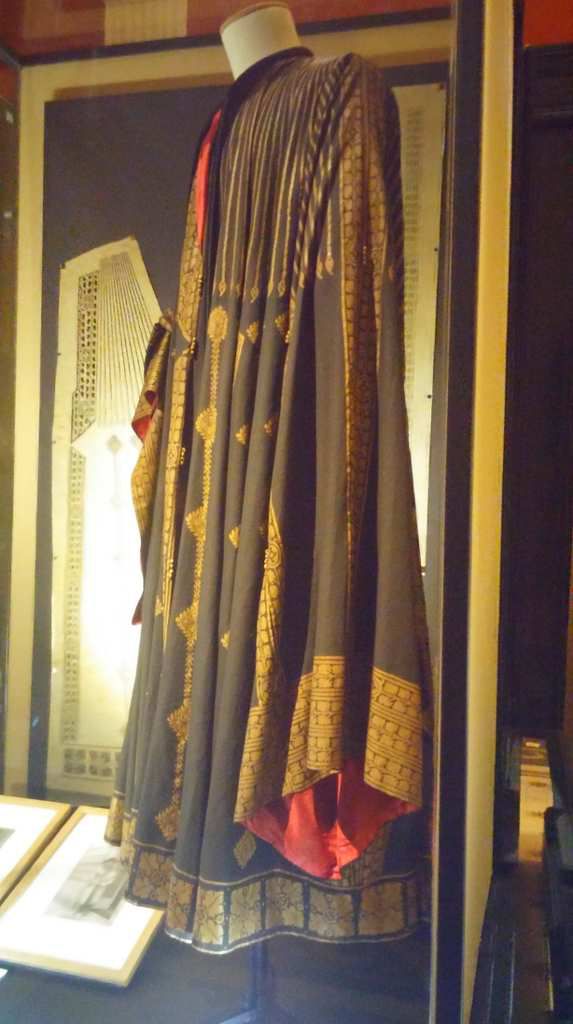
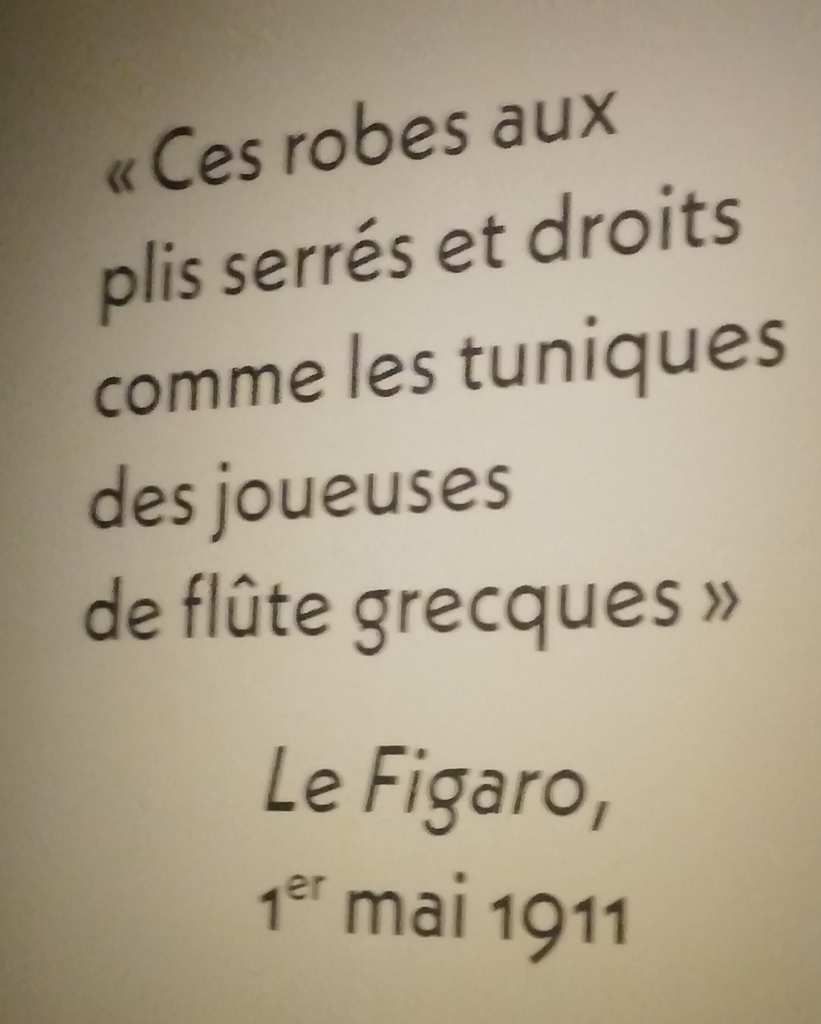
Photographe, graveur, Mariano Fortuny après s’être orienté vers la peinture se tourne vers le textile vers 1906. Espagnol de naissance, ce styliste au doigt d’or, s’installe à Venise d’où son surnom de « Magicien de Venise ». Il se fait découvrir en 1911 à une exposition à L’Union centrale des arts décoratifs à Paris. La presse découvre ses créations (robes d’intérieur et d’extérieur, décoration d’intérieur) qu’elle plébiscite.
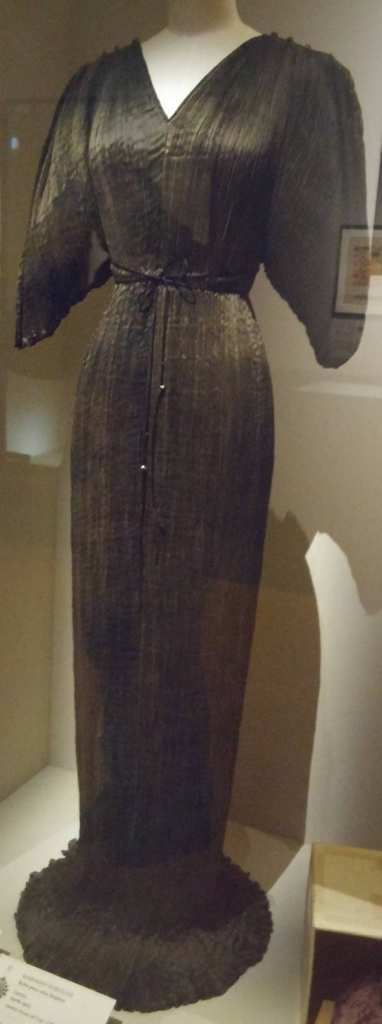
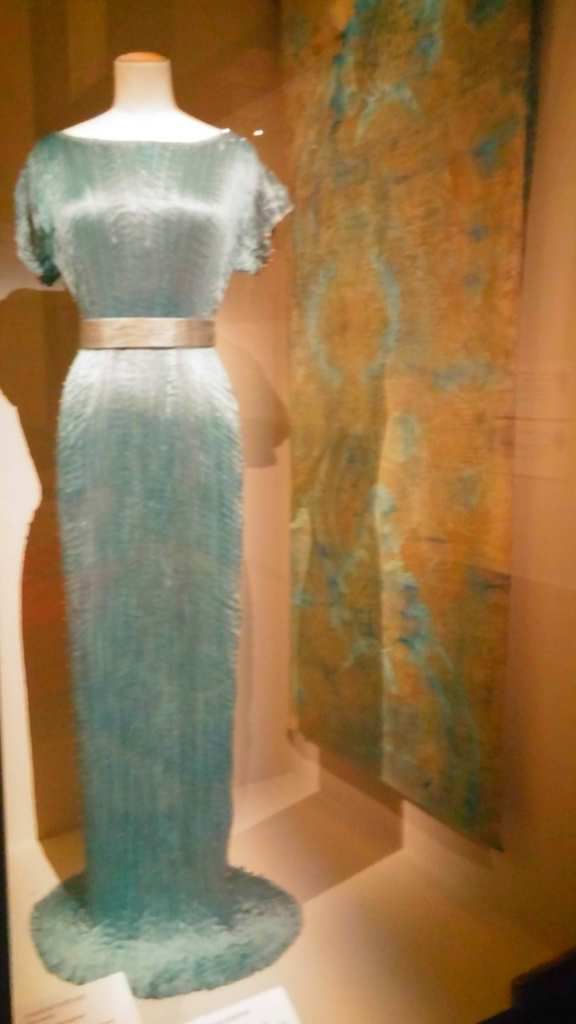
La robe Delphos, dont le plissé et l’ondulation sont inspirés de la toge de l’Aurige de Delphes, ne manque pas de séduire l’élite artistique que fréquente Marcel Proust. Une technique inventée par son épouse Henriette Nigrin, son étroite collaboratrice également.
C’est dans sa résidence personnelle, le Palazzo Pesaro Orfei, à la fois atelier et musée que ses créations voient le jour. Intemporelles, ces dernières s’inspirent tant du Moyen Âge, de l’Antique gréco-romaine, de la Renaissance et aussi de l’époque arabo-andalouse de l’Égypte et de Byzance. Comme matières premières, il utilise le velours, la gaze mais aussi la soie importée du Japon. Les procédés d’impression sont multiples et complexes. Estampage à la planche en bois entre autres.
Mariano Fortuny compte dans sa clientèle des personnalités riches et célèbres comme Isadora Duncan, la marquise Casati, Anna Pavlova, Alma Malher, Jeanne Lanvin et bien d’autres. Séduit par la coupe de son célèbre ami de styliste, Marcelle écrit dans La Prisonnière (1923): « De toutes les robes ou robes de chambres que portait Mme de Guermantes, celles qui semblaient le plus répondre à une intention déterminée, être pourvues d’une signification spéciale, c’était ces robes que Fortuny a faites d’après d’antiques dessins de Venise. […] Avant de revêtir celle-ci ou celle-là, la femme a eu à faire un choix entre deux robes et non pas à peu près pareilles, mais profondément individuelle chacune et qu’on pourrait nommer. » ou encore « Le miroitement de l’étoffe d’un bleu profond, qui au fur et à mesure que mon regard s’y avançait, se changeait en or malléable par ces transmutations qui, devant la gondole qui s’avance, changent en métal flamboyant l’azur du Grand Canal. »*
Le texte ci-dessus a été sélectionné pour paraître dans le 2ème volet sur les femmes, peinture et poésie (sommaire à venir).
***
Pour citer ce texte
Maggy de Coster (texte et photographies), « Les chefs-d’œuvre de Mariano Fortuny au Palais Galliera », Le Pan poétique des muses|Revue féministe, internationale & multilingue de poésie entre théories & pratiques: Lettre n°13, mis en ligne le 16 janvier 2018. Url : http://www.pandesmuses.fr/2018/1/mariano-fortuny
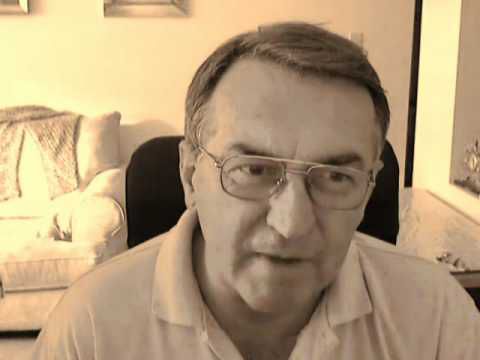
Tatjana Debeljački – Generally speaking, what advice would you give us about author’s temptation ? Please provide an example of « what not to do ? »
Ibrahim Honjo – When writing, authors encounter a variety of temptations that can be helpful in writing or which disorient the author, taking him/her in the opposite direction. In any case, we need to write the way we feel at that moment so that we do not to lose the idea and the coming thoughts and get lost in the idea itself. What we do not write down is lost. This is a « luxury » which an author cannot and should not allow to happen.
Everything we write needs to be left for some time to « age » and then it has to be re-done from time to time and improved. Personally, I work for 4-5 years on every book of poems. This means that I return to each poem several times as well as to each book as a whole, until I make sure that it is how I want it. Even so, when the book sees the light of day, I discover that I did not write something in that period the way I would write it today. That is why a poem is never finished, although it is a reflection of the moment in which it was created.
Each poem must have a message and a lesson. You do not need to write a poem so that everything fits well, and then the readers would be right to ask what the poet wanted to say. A poem must not be wonderful to the ear and empty in the spirit.
TD – Balance of scenery of desire and ambition, beauty secret of success ?
IH – Desire is not a direct ruler of thought. An author wants and tends to write as good a poem as possible, to write and publish a book that readers will be happy to read. Some succeed in doing so, some less, and there are those who fail. The path to success does not depend only on an author, although it is the basis, but also on a publisher who recognizes the quality and who is willing to invest money in marketing that work, because without good marketing there is no success. In my opinion, there are no other special secrets of success. There are a number of subjective and objective circumstances. Today, the situation in the publishing industry is significantly different than it was 20 years ago. More and more publishers tend to make authors invest in their own work. The number of traditional publishers is decreasing from day to day. This led to hyper production. Books are more and more often self-published. We should not even talk about quality. Many books are published only because their authors thought it would make them rich, and in reality, only their publishers get rich, promoting self-publishing with the high cost of services paid by many authors who are trying to publish a book hoping that they will earn a lot of money. The real truth is that they usually lose even ten thousand dollars in their publishing ventures. In the end, they realize that there is no profit, but that it's still a nice feeling to have their own printed work in their hands. My personal ambition is to write and write. If one of them is published by a publisher someday, because my work is good and useful for other people, then it is a success. Therefore, the secret of success is in the high-quality educational work and the publisher's commitment to launching exactly this work into life.
TD – Creation aims to leave a mark, the mark of faith in people and humanity, and this faith does not leave you ?
IH – Of course, creativity is not the only purpose on its own. An author seeks his work to live in people and with people as long as possible, to leave a mark on the time in which the author lives. An author believes in what he offers to the readers of his work. He lives with this faith, but often during this author's life his/her work is not noticed nor accepted by a broader circle of the reading audience. Many creations become famous after the death of an author, and some never, meaning that some authors failed to leave the desired mark on people as a gift. And yet they died believing in people and humanity and hoping that someday, somebody would still discover the value of their creation and give it life.
TD – Do you express ease of writing, the dominance of passion and culmination ?
IH – It is not easy to write in spite of the passion that the author feels in his writing. Writing is not just arranging letters, words, verses and sentences into one whole. Writing is the lust for the love of creation, which fills every pore of author’s body. It is a combination of feelings and life pictures that need to be woven into a creation which is acceptable primarily to the author himself, and to readers, framing the passion of writing in order to reach the culmination we strive for, and reach our own imaginary citadel.
TD – On the wings of the intimate, radiant empires remain in the curiosity of an author ?
IH – An author’s curiosity has no limits. It differs from author to author. Every author has his/her own dazzling intimate empire in which he/she closes themselves trying to extract the tiniest and most beautiful threads and give them to readers, the way he/she feels and experiences it. How much the author will succeed in this depends on his/her creative abilities and knowledge.
TD – Do you feel that your writing process is continually evolving, or have you found a way for your memory to always readily work for you ?
IH – It is quite normal for the writing process to constantly evolve. Following my literary path, I noticed the progress of my creations. By writing, we actually learn to write and develop the writing process. This process starts with the first written verses or sentences and never stops as long as the author creates. Personally, I permanently seek and strive to perfect this process by nurturing such memory and keeping it ready to always be in line with my creativity.
TD – All poets were a little scared with insomnia in them ?
IH – I would rather say that poets are afraid of themselves in their mind and that it causes insomnia that causes fear of a fall, but sometimes it helps them to write and sometimes it stops them. It is a fear of flying in the orbit of words, in which flying gets us to the final destination, a poem in which a poet can easily trip over his own words and break his wings if he does not ground himself/herself in time. So, we should know how to fly and ground ourselves on time.
TD – Who is Ibrahim Honjo, in a civilizational and also in the artistic sense of consciousness and conscience ?
IH – Ibrahim Honjo is in every way an ordinary man who persistently tries to describe himself in this world and this world in him through personal experiences and the experiences of others. He is a man who loves people and humanity regardless of skin color, nationality and faith. A man who knows how to love and who strives for the idea that love rules the world or as the Bible says to love your neighbour and even your enemies. In my work, the theme is dominantly love, and love is also sprinkled in every poem regardless of the theme of them poem. In 2010, I created a simple formula for love LOVE + LOVE = LOVE. Unfortunately, I do not believe that this formula will come to life because there are many more people who cultivate hatred, which is not a characteristic of poets. A poet's heart is wrapped in love, so I can rightly say that poets are angels of love and they are in large numbers.
TD – What inspires you most when writing ?
IH – A poem is a description of a single moment that awakens by inspiration. The first written thought colours the moment of inspiration with different colors that I arrange according to shades and their similarities, interweaving them in poems. These shades have an inspirational character and lead me through the moment. Inspiration is not one-sided and it's not the same with writing all poems. These shades are always different and they always move the world inside me, leaving me to the world in which I live.
TD – Have you ever been tempted to return and change your potential ?
IH – The ability to create is different from poem to poem. Sometimes it is stronger, sometimes weaker, which depends on the strength of the inspiration caused by the accumulation of emotions. Inspiration depends on the motivation to write something, and motivation by the very subject that spontaneously imposed itself on me, or it is a product of a desire to write a poem about it or to write something else. Certainly, I return to my writing from time to time, and I try to change everything to the best of my ability.
TD – Do you enjoy with all senses with experience and passions of the gift ?
IH – My gift of writing is innate. When I discovered this gift as a high school student, I began to nurture and develop it. Indeed, with every pore of my being, I enjoy turning my experience into a poem or some other creative form (story, aphorism, novel, painting, photography, sculpture), bringing all the passion of writing, and sharing this experience with people unselfishly. My greatest pleasure is when a reader writes a message to me and says that my poem « opened » his or her eyes and helped him or her to understand and explain some things that were not entirely clear and acceptable. It's a really wonderful feeling and a great reward.
TD – What can we expect from you in the near future on the creative agenda?
IH – I have never specifically occupied myself with the future nor planned it because it is unpredictable. I'm trying to be objective and grounded, to remain in the framework of this day. Today is reality because it is here and it marks the time of the present. The future is close or distant, uncertain and unpredictable. It is just like a ray in my subconscious, as something that will come and become today. Desires are closely linked with today and with the future, even more with the future.
In the coming period I want to publish several books of poetry, a book of aphorisms, short stories and thoughts, a novel, « Some other pain and another laughter », to finish writing and publish my novel « Capitalism Yes, but ... » and to re-write and re-publish my autobiography, which was published in 2011by one of the largest American publishers, « Publish America. »
Gratitude to the gentleman with nice manners for an interview. Thank you all for giving me the opportunity to share this with the public.
***
Some poems by/quelques poèmes par Ibrahim Honjo
Ode to your eyes
In your eyes the color of blue pearl, Rebecca
red fish swim as rubies
all the way from Jerusalem
this landscape reminds me of
a plantation of lilies in the Netherlands
in your eyes I sometimes see
the promise of a million cracked open skies
in them resting subtle honesty
and dormant sparks of love
that I want to flare up in a blaze of passion
in your eyes waves of the Adriatic waters
in them the white Krka waterfalls
in them the waters of the Danube and Sava reflect
in them, the Plitvice Lakes
Atlantic, Pacific and the mighty Niagara Falls
your eyes exude a propagated smile
the morning dew and summer rain
illuminating the universe
and the infinite rainbows embracing the universe
from your eyes a secret like a bird will rush out
I feel, there will be a cloudburst soon
and I will not be there to stop it
and spare your eyes from filling with tears Rebecca
all this will remain a big secret
upon which the birds daydream in their cages
They dream of your eyes, Rebecca
***
Way to Eden
I will knit a scarf for you
from the wind
and string together
a necklace of haze
I'll make bracelets
of nocturnal shadows
I'll make you a bed
of the moon phase
cover you with my glances
and wake you up in the sun's rays
I'll wash you with drops of dew
from the most beautiful and aromatic flowers
I'll wrap you in the tender rhapsody
of my glistening silhouette
we will walk in fervent embrace
from here to Eden
***
Dreams the changed Ana
I'll trick you and take you to the North Pole, Ana
there I will look after you as little drops of water in my palm
there I'll warm you up with love
I'll make the most beautiful city of ice in all colors for us
and decorate it with crystal dreams
I will keep you away from all spells and all earthly evils
I'll build you a big ice aquarium
with a million blue fish and a million pearl shells
I'll make sleds from carved ice crystals
and drag them around the North Pole
up to the big ice star
while you dream our dreams
and hide us in them secretly
all will envy us that we have found shelter
for the two of us in unfulfilled dreams
coming true in unrationed bites of Mahalla
that always surprise
the playpen with large ice walls
that fire cannot melt
we'll sail on ice floes
that float toward Newfoundland
we'll play with penguins all night long
and eat fresh sea fruits
I will host the greatest earthly Ball
in your honor
once a month
we will dance with dolphins
and whisper to them the origin of life
in our undefined world
we will show them how we kiss each other
until the ice under our feet becomes
beautiful crystal figurines
Ana, if you dream about me tonight
pretend I'm holding you in my arms and kissing you
on our yacht of blue ice crystals
while the sun goes down in your heart
I'll bring you a handful of the most beautiful diamonds
hidden deep in the waters of Antarctica
and I will make the most unusual string of pearls for you
and dress your beautiful neck vividly
as I once did with oxeye daisies
I'll teach you how easy it is to love me
in all seasons
in all the constellations
Ana you know I do not lie to you
Keep hiding in your dream…
the one I enjoy most
and have a beautiful life
because I cannot hide from it
cannot protect against all Mahalla’s dangers
life is too short to allow it to dissipate around Mahalla
but those dreams with you are something else
something that could outlive even myself
***
The oldest cypress in Mahalla
I will not talk about the bey Karađoz
nor of the fountains in my backyard
I'll show you the oldest cypress in the world
we will sit and kiss at his roots
branched in all possible directions
we will hide in our glances
Cicadas will sing their famous song to us
we'll listen and learn the history written in stone
others will invent it and retell it
the way it should sound
right for them
altering facts about everything
do not be surprised if they accuse us
of treason and declare us heretics
continue to love me
the fact is
our cypress is strong and steady
I wish you and I to be like the cypress
and following consistently
united we’d grow tall
to reach the stars
***
Legend about my grandfather
My grandfather, whom I do not remember
has never had a fiddle
has never seen a piano
yet he played both at the same time
with a pitchfork he played the violin
with a hoe he chose the notes on the piano
he played better than Mozart and Beethoven
while playing he enjoyed invisible walls
in an imaginary castle
with him African and South American parrots were singing
deer and rattlesnakes were dancing the waltz
and Native Americans synchronized smoke signal rhythms
with each note
spreading peace on the planet
he taught his four hundred goats and three hundred sheep
to sing in the choir
when he played love songs
that he composed
picking pumpkins in the fall
and making brandy the first days of winter
about my grandfather the legend said
bears and lions smoked the peace pipe
and drank water from the same source
my grandfather was the first minstrel in Mahalla
also the first pianist and violinist
he played the violin that he made
out of the one maple tree that grew in front of our house
just to keep alive peace on the planet
so he made the biggest bridge between continents
that no one has ever used out of spite
they say when my grandfather shouted
from the top of the mountain
the world’s army lined up in an instant
and paid respect to those who they murdered
in sign of support, my grandfather hugged his sweetheart
and kissed her until the apples didn't bloom in Mahalla
and peace with peace did not fertilize in peace
***
Inferno
They danced, ate, drank, sang
I broke my own hands
broke my own feet
plucked my hair and ears
scratched my face
broke everything what was mine
eventually, I gouged my eyes out
took out my heart
and threw it in front of raging beasts
and allowed it to sweeten
I gave them all my insane blood
quenched their thirst
they were greedy and dirty
as small starving children
after a chocolate dessert
and it wasn’t enough to them
they wanted my bones too
naked and without a soul
that part of me was strong
and laughed at their greed
insanely, creepy in one single cry
Mahalla has turned into an echo
beasts have turned into balls
rolled down side streets
my skeleton has become an unruly scarecrow
so I stopped this madness
Mahalla was finally breathing more easily
and I peacefully drifted away to sleep
then woke up from this horror
and declared it Honjo’s inferno
***
To quote this poetic interview /Pour citer cet entretien poétique
Tatjana Debeljački, « Interview with Ibrahim Honjo», Le Pan poétique des muses|Revue féministe, internationale & multilingue de poésie entre théories & pratiques: Lettre n°13, mis en ligne le 16 janvier 2018. Url : http://www.pandesmuses.fr/2018/1/ibrahim-honjo
Mokhtar El Amraoui, « Ô Mère ! », Le Pan poétique des muses|Revue féministe, internationale & multilingue de poésie entre théories & pratiques: « Le calendrier 2018 des poèmes pour lutter contre les violences faites aux femmes, enfants & minorités », mis en ligne le 16 janvier 2018. Url : http://www.pandesmuses.fr/calendrier2018/16mere
Le temps m’étend, me consume. Des moments de grâce, de tristesse, de rien s'improvisent une vie.
Voici le court récit d'une autopsie de la vie.
Vivre, c'est fourvoyer, c'est apprendre à mourir*.
L'écriture est une musique du soi, un chant bigré du monde.
Souvent lorsque j'ai mal de vivre, je me réfugie dans le silence salvateur.
Souvent lorsque les larmes deviennent des lacs et les lacs des mers violettes, je pars en partance, là où s'arrête le monde, où demeure le blanc de la page blanche ou celui d'une vie.
Vivre, c'est écrire et écrire c'est vivre. Sans l'écriture, la mort s'empare du reste.
Le blanc d'une page, d'une vie, m'appelle puis me fait noyer dans l'absurde.
Souvent mon radeau s'élance tel un navire ontologique du soi pour atteindre un rivage remémoré. Souvent les cordes accordées d'un violon transforment mon radeau en chapelle gothique où un dieu perplexe se meurt et une déesse violette bleutée de tristesses voit le jour.
Souvent lorsque j'ai mal d'écrire, je pars en partance, en soi-disant moi, dans l'à-peu-près du moi.
Devenir un mot, un mot mouvant, invisible, indivisible, pluriel, une chose non assignée, un mot muet…
...et questionner l'orgueil d'un jour qui se lève au loin, demeurée autre, dans l'inquiétude...
Le je me voue à l'oubli ; à une célébrité qui m’écœure le cœur.
Je voudrais écrire avec l'invisible souffle du vent, avec la couleur limpide des larmes, avec l'arc-en-ciel, avec les chérubins des cieux antiques et modernes, avec les mèches de tes cheveux, toi liberté chérie qui me nargues souvent, m'apportes la nausée divine tous les matins, toi liberté chérie, muse lointaine, bohémienne, volage, ne t'attaches plus à moi pauvre mortelle ensevelie dans les souillures des signes sans cygnes, ni cieux bleus à atteindre. Mes signes s'entassent en pages tels les cadavres et, les génocides des mots ne suffissent guère à arrêter les misères des humains. L'écriture est une crucification des signes.
Ce poème en prose a été sélectionné pour paraître dans un de nos numéros imprimés de 2018.
***
Pour citer ce poème inédit en prose
Dina Sahyouni, « Sarabande ou vision lugubre », Le Pan poétique des muses|Revue féministe, internationale & multilingue de poésie entre théories & pratiques: Lettre n°13 & N°9 | Fin d'Été 2021 « Femmes, Poésie & Peinture » sous la direction de Maggy de Coster, mis en ligne le 15 janvier 2018. Url : http://www.pandesmuses.fr/2018/1/sarabande
Le poème « Mer-Mère » a été sélectionné pour paraître dans un de nos numéros imprimés.
***
Pour citer ce poème
Mokhtar El Amraoui, « Mer-Mère », Le Pan poétique des muses|Revue féministe, internationale & multilingue de poésie entre théories & pratiques: Lettre n°13, mis en ligne le 13 janvier 2018. Url : http://www.pandesmuses.fr/2018/1/mer-mere
Bienvenue à la directrice de publication du site Simone Durand (elle collabore et remplace en ligne la directrice-fondatrice de la presse de la SIEFEGP à partir de septembre 2026).
LPPDM, SEPTEMBRE 2026
La rédaction lyonnaise reprend son activité éditoriale après un arrêt de l'actualisation de ce site (suite au décès d'un proche).
L’association SIÉFÉGP publiera en 2026 ses anthologies livresques composées de vos écrits poétiques sur des thèmes déjà proposés par la rédaction.
SIÉFÉGP, JUIN 2026
APPEL PERMANENT À ARTICLES ENCYCLOPÉDIQUES POUR NOTRE ENCYCLOPÉDIE UNIVERSELLE ET NUMÉRIQUE (LANCÉE EN 2012) SUR LES POÉTESSES (FEMMES POÈTES, POÈTES, POÉTRIDES, ETC.) DE TOUTES LES PÉRIODES, ET DANS UNE OU PLUSIEURS LANGUES. CHAQUE ARTICLE DOIT PORTER SUR LA VIE, L'ŒUVRE ET LA POSTÉRITÉ DE LA CRÉATRICE CHOISIE.
Cette section n'a pas été mise à jour depuis longtemps, elle est en travaux. Veuillez patienter et merci de consulter la page Accueil de ce périodique.
N° III AUTOMNE 2026 | NUMÉRO SPÉCIAL « MÉTAPOÉSIE AU FÉMININ », 1ER VOLET | Critique & réception | Dossier mineur Articles & témoignages | Revue Matrimoine Emma Lazarus, La Liberté éclairant le Monde (Poésie au fil de la vie). Sélection & traduction des...
N° III AUTOMNE 2026 | NUMÉRO SPÉCIAL « MÉTAPOÉSIE AU FÉMININ », 1ER VOLET | Bémols artistiques | Critique & réception / Chroniques de Camillæ Sur la route des Princes voyageurs, de 1446 à 1560. Exposition au château d’Amboise, été 2026 Critique & photographies...
Biographie & publication disponibles numériquement Jesús Rafael MARCANO GUZMÁN Écrivain, poète & orientaliste vénézuélien, pratiquant le Xiulian
Lien biographique complémentaire en espagnol du poète.
Lin Xianhe 林仙鹤, également connu sous le nom de « Samouraï...
Biographie & publication disponibles numériquement Fadila ZEDIRA-DERBAL Autrice, poétesse engagée pour l’émancipation des femmes
Autrice, Fadila ZEDIRA-DERBAL a la plume à la fois charnelle et éthérée, elle explore à travers ses écrits les fêlures cachées...
/image%2F1507988%2F20180106%2Fob_15ea4f_lyre.png)


/idata%2F4988801%2FCarte-virtuelle-poeme-d-amour-inedit-a-offrir%2FCarte-virtuelle---Je-voudrais--.jpg)
/idata%2F4988801%2FCartes%2FCarte-Laodicee.jpg)
/idata%2F4988801%2FLeiladarocha---partickdupond%2Fpage1.jpg)
/idata%2F4988801%2FExposition-de-Filomena-Salley%2FTableau-Filomena-Salley.jpg)
/idata%2F4988801%2FTableaux-de-l-artiste-peintre-Filomena-Salley%2FTableau1-de-l-artiste-peintre-Filomena-Salley.JPG)
